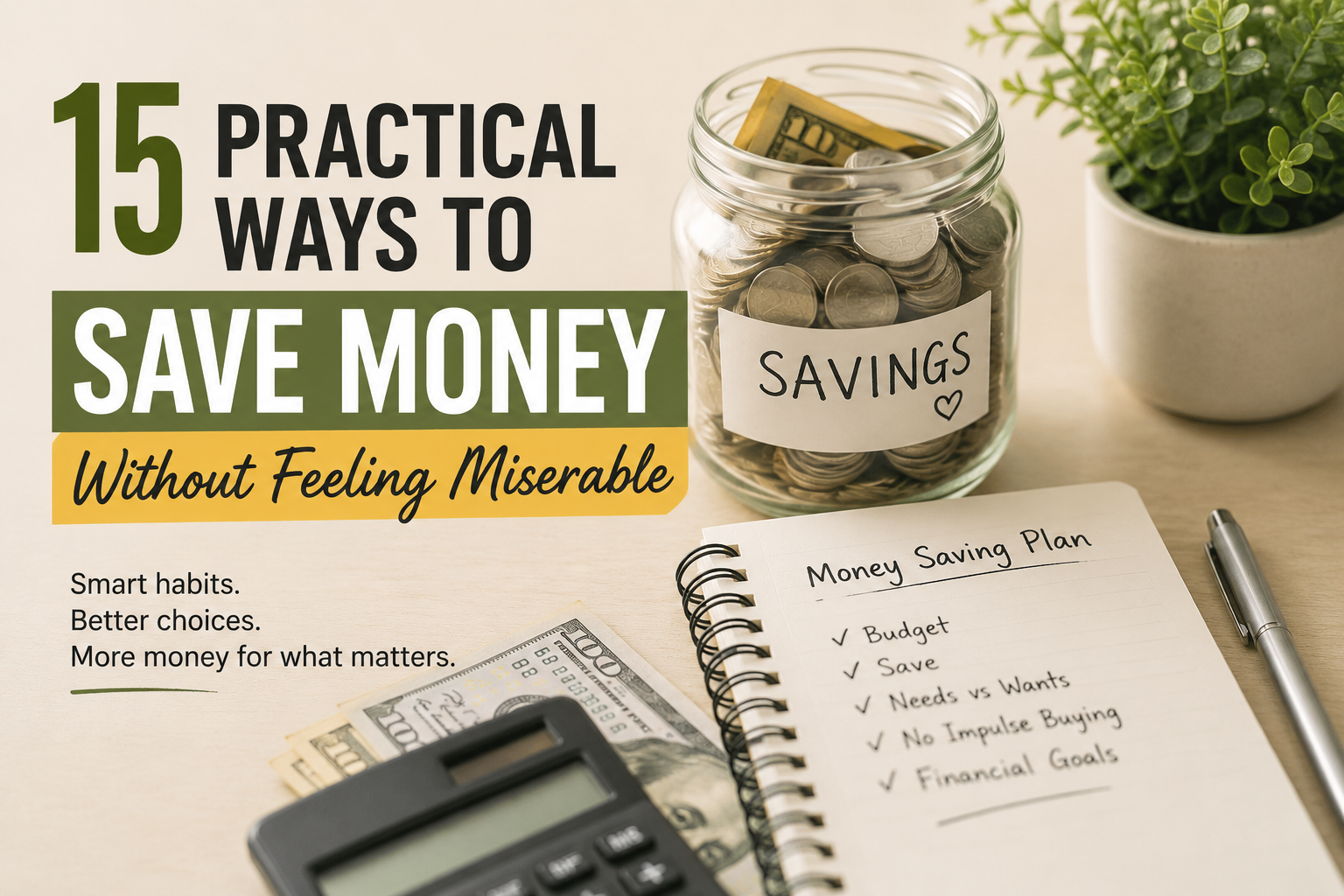
Saving money does not have to mean giving up everything you enjoy. In fact, the best way to save money is to build habits that make your life easier while reducing unnecessary spending.
You do not need an extreme budget, a completely restrictive lifestyle, or a long list of things you can never buy again. Small, realistic changes can make a noticeable difference over time.
Whether you are trying to build an emergency fund, reach a financial goal, or simply have more money left at the end of the month, these 15 practical money-saving tips can help you spend smarter without feeling deprived.
1. Track Where Your Money Actually Goes
Before trying to save money, understand your current spending.
For one month, keep track of everything you spend, including small purchases such as coffee, snacks, delivery fees, subscriptions, and online shopping.
You may discover that some expenses are much higher than you expected.
The goal is not to judge yourself. It is simply to identify where your money is going.
Once you know your spending patterns, you can decide what is worth keeping and what can be reduced.

2. Use the 24-Hour Rule for Impulse Purchases
Online shopping makes it incredibly easy to buy something within seconds.
Instead of immediately purchasing something you want, wait 24 hours.
Add the item to your wishlist or leave it in your cart and come back the next day. If you still want it and it fits your budget, you can consider buying it.
This simple pause helps separate genuine needs and long-term wants from temporary excitement.
For expensive purchases, you can extend the waiting period to a week.
3. Create a “Fun Money” Budget
One of the biggest reasons strict budgets fail is that they leave no room for enjoyment.
Instead of completely eliminating entertainment, shopping, eating out, or hobbies, create a specific fun money budget.
For example, you might decide that a certain amount each month is available for restaurants, movies, clothes, hobbies, or other personal purchases.
Once that money is spent, you wait until the next month.
This gives you freedom while still keeping your overall spending under control.
4. Cook More Meals at Home
You do not have to stop eating out completely.
Instead, try replacing a few restaurant or food-delivery meals with homemade versions each week.
Cooking at home can also be easier when you keep a few simple meals in rotation.
You could prepare rice bowls, sandwiches, pasta, wraps, salads, or other quick meals that do not require complicated recipes.
The goal is convenience without constantly paying restaurant prices.

5. Plan Your Grocery Shopping
A grocery list can prevent surprisingly large amounts of unnecessary spending.
Before going shopping, check what you already have at home. Then make a list based on the meals you actually plan to prepare.
Try not to shop when you are extremely hungry because it can make impulse purchases more tempting.
You can also compare prices, choose store brands when they offer good value, and avoid buying large quantities of food simply because they are on sale.
A discount is not a saving if you would not have bought the product otherwise.
6. Cancel Subscriptions You Barely Use
Take a look at your recurring payments.
You might be paying for streaming services, apps, memberships, cloud storage, or other subscriptions that you rarely use.
Ask yourself:
“Did I use this enough last month to justify paying for it?”
If the answer is no, cancel it.
You can always subscribe again later if you genuinely need the service.

7. Make Your Home Work Harder for You
Before buying something new, look around your home and think about whether you already own something that can solve the problem.
An old jar can become storage. A spare container can organize small items. Clothes you rarely wear might be altered or reused.
This mindset reduces unnecessary purchases and encourages you to get more value from things you already own.
8. Use the “One In, One Out” Rule
This is particularly useful for clothes, shoes, accessories, kitchen items, and other belongings.
Whenever you buy something new, consider removing something similar that you no longer use.
For example, if you buy a new jacket, you might donate or sell an old jacket you rarely wear.
This prevents your home from becoming overcrowded and makes you think twice before buying something you do not really need.
9. Compare Prices Before Big Purchases
For expensive purchases, avoid buying the first option you find.
Compare prices from different stores and check whether there are better alternatives.
Also consider the total cost of owning the product. A cheaper item is not always better if it breaks quickly and needs to be replaced.
Think about value, quality, durability, and usefulness, rather than focusing only on the initial price.
10. Learn to Wait for Sales—Without Chasing Them
Sales can help you save money, but they can also encourage you to spend more.
Instead of browsing sales looking for something to buy, make a list of things you already planned to purchase.
Then wait for a suitable discount.
This changes your mindset from:
“What can I buy because it is on sale?”
to:
“Can I save money on something I already planned to buy?”
That small difference can protect your budget from unnecessary shopping.
11. Try a “No-Spend” Day
A no-spend day means you avoid unnecessary purchases for one day.
You can still use things you already have at home, prepare your own food, and enjoy free activities.
You could read, exercise, watch a movie you already have access to, organize your room, take a walk, or spend time with friends and family.
You do not need to turn this into an extreme challenge. Even one or two no-spend days each week can make you more aware of your spending habits.

12. Reduce Convenience Spending
Convenience is useful, but constantly paying for it can become expensive.
Examples include food delivery, frequent ride-hailing, paid delivery fees, last-minute purchases, and paying someone for tasks you could reasonably do yourself.
You do not have to eliminate convenience completely.
Instead, decide which conveniences are genuinely worth paying for and which ones have simply become habits.
Saving money should make your life better, not significantly harder.
13. Automate Your Savings
Saving whatever money is left at the end of the month often does not work.
A better approach is to save first.
Set up an automatic transfer to your savings account after receiving your income.
Even a small amount can help you develop consistency.
For example, saving ₹500 or ₹1,000 regularly may seem small at first, but the habit becomes more valuable as your income and savings grow.
The important thing is to choose an amount that fits comfortably within your budget.
14. Find Free or Low-Cost Alternatives
Entertainment does not always have to be expensive.
Instead of going to expensive restaurants every weekend, you could have a homemade dinner with friends.
Instead of paying for an activity, you could visit a park, explore your city, exercise outdoors, borrow books from a library, or attend free community events.
The point is not that paid experiences are bad.
It is simply useful to remember that fun does not always have to come with a large price tag.
15. Focus on Spending Better, Not Spending Nothing
Perhaps the most important money-saving habit is changing how you think about spending.
The goal is not to become someone who never spends money.
The goal is to spend intentionally.
Ask yourself before making a purchase:
- Do I actually need this?
- Will I use it regularly?
- Does it fit my budget?
- Is there a cheaper alternative?
- Am I buying it because I genuinely want it or because I am bored, stressed, or influenced by social media?
When you become more intentional, saving money becomes less about restriction and more about making choices that support your priorities.
Final Thoughts
Saving money does not have to mean living a boring or miserable life.
You can still enjoy your favorite food, go out with friends, buy things you love, and spend money on experiences. The difference is that you become more intentional about where your money goes.
Start with just two or three changes from this list. Track your spending, create a realistic fun-money budget, reduce impulse purchases, and automate a small amount of savings.
You do not need to transform your finances overnight.
Small habits repeated consistently can create much bigger results than extreme money-saving challenges that you cannot maintain.
The goal is simple: spend on what matters to you, reduce what does not, and give your money a purpose.