
Author name: Anjali

Woman deciding what to keep, throw away and stop buying
Uncategorized

What to Keep, What to Throw Away & What to Stop Buying

There is a point when your home starts feeling full even though you don’t think you’ve bought that much. A drawer won’t close properly. Your wardrobe has clothes you haven’t worn in years. The kitchen has three versions of the same thing. Your bathroom is full of products you bought because they looked useful but barely touched. And then there’s the shopping. You see something that looks convenient, beautiful, or useful and think: “Maybe I’ll need this someday.” So you buy it. Months later, you’re wondering why you have so much stuff. The answer isn’t always that you need to become a minimalist or throw away half your belongings. Sometimes you simply need to become more intentional about what to keep, what to throw away and what to stop buying. You don’t need an empty home. You need a home where the things you own actually earn their space. Why It’s So Hard to Decide What to Keep Getting rid of things sounds easy until you actually pick something up. Suddenly you remember how much you paid for it. Or you think: “What if I need it later?” “Someone gave this to me.” “I might use it someday.” “It still looks perfectly fine.” These thoughts can make decluttering much harder than it needs to be. Instead of asking whether something is technically usable, ask a more useful question: “Does this still have a useful place in my life?” Something can be perfectly good and still not be useful to you anymore. That’s the difference between throwing things away randomly and making thoughtful decisions about what deserves to stay. What to Keep Let’s start with the easiest category. You don’t need to get rid of everything. There are plenty of things worth keeping. 1. Things You Use Regularly This sounds obvious, but regular use is one of the simplest signs that something deserves its place. Keep the things you genuinely reach for. Your favorite everyday clothes. The pan you actually cook with. The bag you use all the time. The skincare products that work for you. The notebook you regularly use. These things are earning their space. You don’t need to feel guilty about keeping them just because you own a lot of them. 2. Things That Solve a Real Problem A useful item doesn’t necessarily have to be used every day. Some things are worth keeping because they solve a specific problem when you need them. For example: A basic first-aid kit Important documents A reliable umbrella A tool you occasionally need Seasonal clothing Useful travel items Backup household essentials The key is that you know why you have it. If you can immediately explain what an item is for and when you would realistically use it, that’s a good sign. 3. A Few Sentimental Things Decluttering doesn’t mean becoming emotionally detached from your belongings. Keep things that genuinely mean something to you. A photograph. A handwritten note. A meaningful gift. Something connected to an important memory. But you don’t have to keep every object simply because it reminds you of someone. Your memories aren’t stored only inside physical objects. Keep the sentimental things that genuinely make you happy to see. 4. Quality Basics You Actually Use Sometimes keeping one good item is better than constantly replacing several cheap versions. If you have a jacket that fits perfectly, a pair of shoes you wear constantly, or kitchen equipment that has lasted for years, there is no reason to get rid of it simply because it isn’t new. Ask: Would I buy this again today? If the answer is yes, that’s useful information. What to Throw Away This is where things become easier if you stop thinking about what something could be useful for. Think about how it is actually being used. 5. Broken Things You’re Never Going to Fix That broken charger. The bag with the damaged zip. The appliance you’ve been meaning to repair for two years. The chair that has been waiting for a repair since forever. If you genuinely intend to fix something, give yourself a realistic deadline. Otherwise, you’re not really keeping a useful item. You’re keeping a future task. And sometimes getting rid of the broken item feels like removing a tiny responsibility from your mind. 6. Expired or Unusable Products Check your: Bathroom cabinets Makeup drawer Medicine storage Refrigerator Pantry Cleaning supplies If something is expired, spoiled, damaged, or no longer safe to use, it shouldn’t stay simply because you paid for it. Don’t keep something just because you feel bad about wasting money. The money has already been spent. Keeping something you can’t use doesn’t recover that money. 7. Clothes That Don’t Fit Your Real Life Your wardrobe can become crowded with clothes that belong to an imaginary version of your life. Maybe you bought something for a special occasion that never happened. Maybe you used to wear a certain style but don’t anymore. Maybe you keep something because “I’ll wear it when I lose weight.” Be honest with yourself. If you haven’t worn something for a long time and can’t realistically imagine wearing it soon, it may not need to stay in your everyday wardrobe. This doesn’t mean you need to throw away everything you haven’t worn recently. Some clothes are seasonal or occasion-specific. Just don’t let your wardrobe become storage for clothes you don’t actually enjoy wearing. 8. Duplicates You Don’t Need You probably don’t need five versions of the same basic item. Look for duplicates in: Water bottles Mugs Storage containers Bags Kitchen utensils Chargers Notebooks Beauty products Cleaning supplies If you genuinely use all of them, keep them. But if you always reach for the same one, ask why the others are still taking up space. You don’t have to own less for the sake of owning less. You simply need to stop keeping five things when one or two do the job perfectly well. What to Stop Buying This might be the most important section. Decluttering your
Small things that make everyday life easier
Life

Small Things That Make Everyday Life Surprisingly Easier

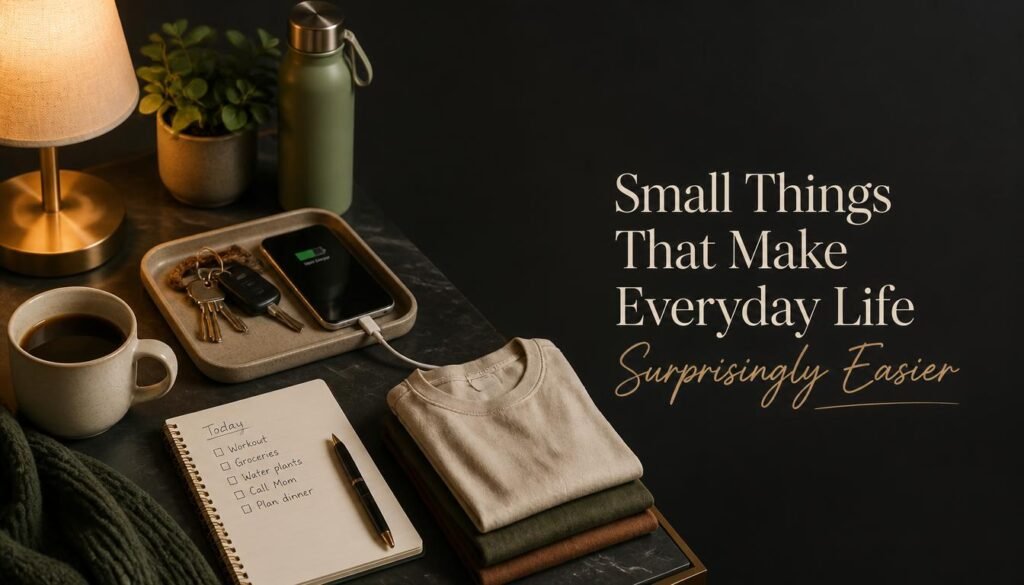
Some days don’t feel difficult because anything major went wrong. They feel difficult because of twenty tiny things. You can’t find your keys. You forgot to charge your phone. You have no idea what to make for dinner. The clothes you wanted to wear are still in the laundry. Your kitchen counter is covered with things you don’t know where to put. None of these problems is huge on its own. But when they keep happening, they can make an ordinary day feel unnecessarily exhausting. The good news is that you don’t always need a complete lifestyle makeover to fix this. Sometimes, a few small things that make everyday life easier can remove a surprising amount of daily friction. These aren’t complicated routines that require waking up at 5 a.m. or spending money on expensive organizers. They’re simple changes you can fit into a normal life. Why Small Changes Can Make Such a Difference When a small task is repeated every day, the time and mental effort can add up. Preparing something the night before, keeping important items in the same place, or writing down tomorrow’s priorities may only take a few minutes. But these small actions can prevent you from repeatedly making the same decisions or searching for the same things. Research on habit formation also suggests that repeatedly connecting a behavior with a routine or cue can help it become more automatic over time. So instead of trying to change everything at once, start by making one part of your day easier. Here are 10 simple places to start. 1. Prepare One Thing for Tomorrow Tonight You don’t have to create an elaborate nighttime routine. Just prepare one thing that tomorrow-you will need. It could be: Choosing tomorrow’s clothes Packing your bag Charging your phone Filling your water bottle Preparing your work items Putting your keys where you’ll find them Writing down an important task for tomorrow This works because you’re solving a future problem before it happens. Imagine waking up already knowing what you’re wearing and where your keys are. That’s a tiny change, but it removes unnecessary decisions from your morning. You don’t need to prepare your entire day. Just ask yourself: “What is one thing I can do tonight that will make tomorrow morning easier?” Then do that one thing. 2. Give Important Things a Permanent Home If you regularly spend five minutes looking for your keys, charger, wallet, headphones, documents, or other essentials, the problem may not be that you’re forgetful. You may simply not have a consistent place for them. Choose a permanent spot for the things you use frequently. For example: Keys → one bowl or hook near the entranceWallet → one specific drawer or trayChargers → one charging areaImportant documents → one folderEveryday bag → one specific hook or chair The goal isn’t to make your home look perfectly organized. The goal is to make finding things easier than losing them. Once you get used to putting something in the same place, you don’t have to think about where it belongs every time. 3. Keep a “Don’t Forget” List Your brain isn’t meant to constantly remember every little thing. Appointments. Bills. Things you need to buy. Messages you need to send. Something you need to take somewhere. An idea you don’t want to forget. Instead of repeatedly telling yourself, “I need to remember this,” write it down. You can use: A notes app A small notebook A planner A simple checklist Your phone’s reminders The important part is having one reliable place for these things. Otherwise, you can end up with reminders scattered across screenshots, messages, random pieces of paper, and your memory. A simple list can make your mind feel much less crowded. 4. Make Your Most-Used Things the Easiest to Reach Look around your home. Are the things you use every day stored in places that make sense? If you use something constantly, you shouldn’t have to move five other things to reach it. Keep frequently used items close to where you actually use them. For example: Keep everyday skincare where you get ready. Keep frequently used kitchen items within easy reach. Keep your work essentials together. Keep cleaning supplies near the areas where you use them. Keep your everyday shoes somewhere accessible. This is one of the simplest small things that make everyday life easier because you’re designing your surroundings around your real life. Your home doesn’t have to look like a showroom. It should work for you. 5. Create a Five-Minute Reset You don’t always need to clean your entire home. Sometimes you just need to stop the mess from getting bigger. Try a five-minute reset at the end of the day. Set a timer and quickly: Put clothes where they belong Clear your main surface Put dishes in the kitchen Return random items to their places Throw away obvious rubbish Put tomorrow’s essentials together When the timer ends, you can stop. That’s the point. You’re not trying to achieve perfection. You’re simply giving your future self a cleaner starting point. Breaking a larger task into smaller pieces can also make it feel more manageable than waiting until everything has accumulated into one huge job. 6. Decide Some Things Once How many times have you stood in front of your wardrobe thinking: “What am I going to wear?” Or opened the refrigerator and thought: “What am I going to eat?” Or spent ten minutes deciding when you’re going to do something you’ve been putting off? Some decisions can be made once and reused. For example, you could have: A few reliable breakfast options A few easy weekday meals A simple morning routine A basic work outfit formula A regular grocery list A standard cleaning schedule A usual place for frequently used items This doesn’t mean every day has to be identical. It simply means you don’t have to reinvent your routine every morning. Reducing unnecessary decisions can leave more mental energy for things that actually require

spend less time on your phone
Digital

How to Spend Less Time on Your Phone Without Becoming a Digital Monk

Your phone can be useful for almost everything. You can work, study, stay in touch with people, manage your money, find directions, take photos, and relax with it. The problem is that it can also quietly take up far more of your day than you intended. You check one notification, open one app, and suddenly 30 minutes have passed. The solution does not have to be throwing your phone into a drawer and living like a digital monk. You can still use your phone regularly while making it less distracting and more intentional. Here are 11 simple ways to spend less time on your phone without completely giving up the things you enjoy. 1. Start by Checking Where Your Time Goes Before changing your phone habits, find out what you are actually doing on your phone. Check your weekly screen-time report and look at which apps take up most of your time. You may discover that your phone use is not coming from one long session. It might be dozens of small checks throughout the day. Ask yourself: Which apps do I spend the most time on? When do I usually start scrolling? Which apps do I open without thinking? What am I usually avoiding when I pick up my phone? You do not need to judge the number. The point is simply to understand your habits before trying to change them. 2. Remove the Apps You Open Without Thinking Some apps become automatic. You unlock your phone, tap the same icon, and start scrolling before you have even decided what you wanted to do. If there are apps you repeatedly open out of habit rather than intention, consider deleting them or moving them somewhere less convenient. You do not necessarily have to remove every social media app. Even moving a distracting app away from your home screen can create a small pause between “I unlocked my phone” and “I’m scrolling.” That pause matters. 3. Turn Off Notifications That Pull You Back Notifications are designed to get your attention. If your phone constantly lights up, vibrates, or makes sounds, you are being given reasons to check it throughout the day. Go through your notification settings and ask whether each app really needs to interrupt you. You can usually keep important notifications such as calls, messages, calendar reminders, banking alerts, or work-related information. For everything else, consider turning notifications off. A sale does not need your immediate attention. Neither does a random social media update. Your phone should not decide when you need to look at it. 4. Move Social Media Off Your Home Screen Your home screen is valuable space. If the first thing you see after unlocking your phone is a row of social media apps, you are more likely to open them automatically. Move distracting apps into a folder or onto another screen. You can also replace them with apps that encourage more intentional use, such as your calendar, notes, reading app, weather, or reminders. This is a small change, but it makes your phone feel less like a place you go to automatically scroll. 5. Create Phone-Free Moments You do not need to make your entire day phone-free. Instead, choose a few specific moments when your phone stays away. For example: During meals While getting ready in the morning During conversations While exercising During your first 30 minutes after waking up During the last 30 minutes before bed Start with one. If you try to create ten strict rules at once, you may quickly get tired of them. One consistent phone-free period is more useful than a complicated system you stop following after three days. 6. Stop Taking Your Phone Everywhere Sometimes the easiest way to use your phone less is to make it less available. If you are going to another room for a few minutes, you do not always need to take your phone with you. If you are eating, leave it somewhere else. If you are doing a short household task, let it stay where it is. This might feel strange at first because we are used to having our phones within reach all the time. But once you stop carrying it everywhere, you may notice how often you were checking it simply because it was available. 7. Make Scrolling Slightly Harder You do not need extreme restrictions to reduce scrolling. Small amounts of friction can help. Try: Logging out of an especially distracting app Removing saved passwords for one app Turning off Autoplay where possible Using app limits Keeping your phone out of reach while working Switching your display to a less visually stimulating setup Removing social media shortcuts The goal is not to make your phone difficult to use. It is to make mindless scrolling require one extra decision. That extra second can sometimes be enough to ask yourself, “Do I actually want to open this?” 8. Replace the Habit, Don’t Just Remove It This is one of the most important parts of learning how to spend less time on your phone. If you remove scrolling but leave a large empty space in your routine, you may simply find yourself reaching for the phone again. Replace the habit with something easy. Instead of automatically scrolling, you could: Read a few pages of a book Make a cup of tea Take a short walk Stretch Listen to music Write in a notebook Tidy one small area Talk to someone Simply sit and do nothing for a few minutes It does not have to be productive. The goal is to become comfortable with having moments when you are not constantly consuming something. 9. Use Your Phone for a Purpose Before opening your phone, try asking: “What am I picking this up for?” Maybe you want to check the weather. Maybe you need to reply to a message. Maybe you need directions. Maybe you want to look something up. Do that thing and put the phone away. This simple habit helps separate intentional phone

digital declutter workspace with laptop, smartphone, and organization checklist
Digital

The Ultimate Digital Declutter: What to Delete, Organize & Turn Off

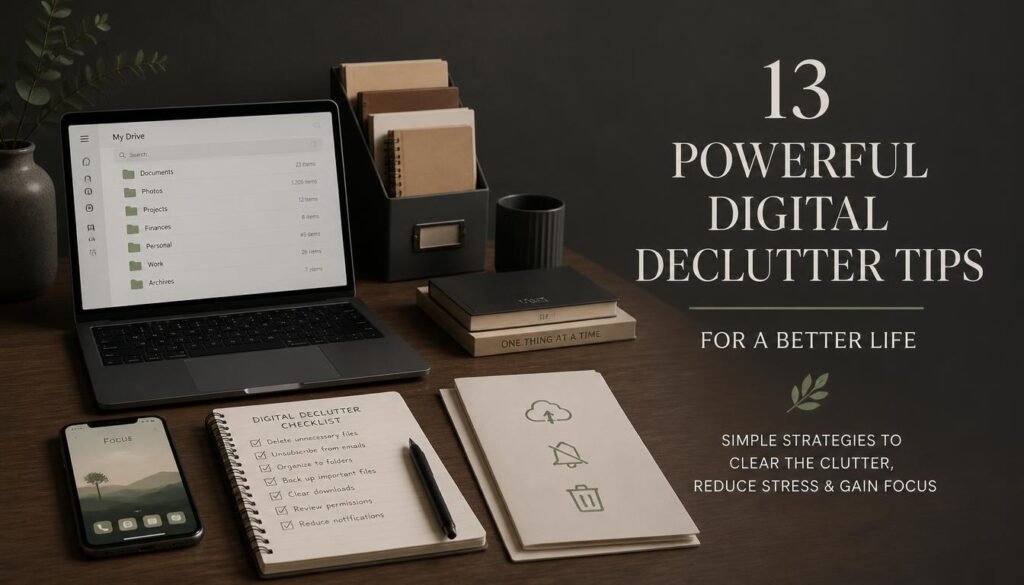
Your phone, laptop, email inbox, cloud storage, and social media can slowly become cluttered without you even noticing. A few unused apps become dozens. Screenshots pile up. Your inbox fills with emails you never read. Notifications keep interrupting you, and finding one important file can suddenly take much longer than it should. That is where a digital declutter can help. You do not need to delete everything or become a digital minimalist. The goal is simply to make your digital life easier to manage by removing things you no longer need, organizing what matters, and turning off unnecessary distractions. Here is a simple digital declutter you can work through without trying to fix everything in one day. What Is a Digital Declutter? A digital declutter is the process of cleaning up the digital spaces you use regularly. This can include your: Phone Computer Email inbox Photos Downloads Cloud storage Social media accounts Browser Apps Notifications Online subscriptions Think of it like cleaning a room. You remove what you no longer need, put important things where they are easy to find, and make the space easier to use. The important part is not making everything look perfectly organized. It is creating a digital environment that works better for your everyday life. 1. Start With Your Phone Your phone is usually the easiest place to begin because you probably use it every day. Start by going through your home screen and asking yourself: Do I actually use this? Delete apps you have not opened in months, duplicate apps, old games, temporary shopping apps, and anything you downloaded for one specific reason but no longer need. You can also move less important apps away from your main screen. Try keeping your first screen for the things you genuinely use, such as communication, calendar, notes, maps, banking, or other important tools. A cleaner home screen can make your phone feel much less overwhelming. 2. Delete Apps You Don’t Use Unused apps do more than take up storage. They can also create unnecessary notifications and make it harder to find the apps you actually need. Look through your complete app list instead of only your home screen. Consider deleting: Apps you have not used in months Duplicate photo or editing apps Old shopping apps Games you no longer play Apps you downloaded once and forgot about Services you no longer use Before deleting anything, make sure you do not need information stored inside the app. If you are unsure, you can always check whether your account or important data is available elsewhere first. 3. Clean Up Your Photos and Screenshots Your photo gallery can become one of the messiest parts of your digital life. Screenshots, blurry photos, duplicate pictures, receipts, old memes, accidental photos, and images downloaded from the internet can quickly take over. You do not need to organize every photo into dozens of folders. Start with the obvious things. Delete: Blurry photos Accidental pictures Duplicate photos Old screenshots Expired information Images you no longer need Multiple versions of the same picture Then create a few useful albums for things you regularly need to find, such as travel, important documents, family, work, or personal projects. The goal is not a perfectly organized gallery. It is simply being able to find what you need without scrolling forever. 4. Clear Your Downloads Folder The Downloads folder is one of those places where digital clutter quietly collects. Old PDFs, images, documents, installers, screenshots, and random files can sit there for years. Open your Downloads folder and sort through it. Delete files you no longer need. For important files, move them into clearly named folders. For example: Documents → Personal → Important Documents Work → Projects → Project Name Study → Notes → Subject Name Use names that make sense to you. You should be able to understand what a file is without opening it. 5. Organize Your Important Digital Files Once you have removed unnecessary files, create a simple system for the ones you want to keep. You do not need ten levels of folders. A few broad categories are usually enough. For example: Personal Work Study Finance Photos Projects Important Documents If you use cloud storage, apply the same basic structure there. Also consider keeping important files backed up in a reliable location. A digital declutter should make your important information easier to find—not easier to lose. 6. Give Your Email Inbox a Reset You do not have to reach “Inbox Zero” to have an organized email account. Start by searching for obvious clutter. Delete emails that have no future value. Then look for emails you may need to keep, such as: Receipts Important bookings Work information Financial documents Account information Important conversations You can create a few folders or labels for emails you need to find later. Keep it simple. If your filing system becomes too complicated, you probably will not use it. 7. Unsubscribe From Emails You Never Read One of the easiest parts of a digital declutter is removing unwanted email subscriptions. Look at the emails you receive regularly and ask: Would I miss this if it stopped arriving? If the answer is no, unsubscribe. This can include: Store promotions Newsletters you never open Promotional offers Old services Notifications from websites you no longer use Do not feel obligated to keep receiving emails simply because you once subscribed. Your inbox should contain information that is useful to you now—not reminders of things you used to care about. 8. Turn Off Unnecessary Notifications Notifications are one of the biggest sources of digital distraction. You do not need every app to have permission to interrupt you. Go through your notification settings and turn off notifications that are not genuinely useful. You might keep notifications for: Calls Important messages Calendar reminders Banking or security alerts Essential work notifications You may not need notifications every time someone posts something, a store has a sale, or an app wants your attention. Your phone does not need to

how to create a personal style with a simple everyday wardrobe
Style

How to Create a Personal Style: 10 Easy Tips That Actually Work

You can save hundreds of outfit photos, buy clothes you thought you’d love, and still stand in front of your closet thinking, “I have no idea what looks good on me.” Maybe you like several completely different styles. Maybe you buy something because it looks great on someone else, only to leave it hanging in your closet. Or maybe you simply don’t know what your style is supposed to be. The good news is that you don’t need to figure it all out at once. Learning how to create a personal style is less about choosing one aesthetic and more about noticing what you actually enjoy wearing. Your favorite colors, comfortable fits, outfits you repeat, and even the clothes you never reach for can all give you useful clues. You also don’t need a completely new wardrobe to start. Here are 10 simple ways to figure out what feels like you and gradually create a personal style that works for your everyday life. What Does Personal Style Actually Mean? Personal style is simply the way you choose to dress based on what you like, what feels comfortable, and what works for your everyday life. It doesn’t mean you have to fit into a specific category like minimalist, classic, feminine, casual, or trendy. You can enjoy simple outfits one day and wear something more feminine or polished the next. Your style can also change depending on where you’re going, the season, your mood, or what you feel comfortable wearing. Instead of asking yourself, “What aesthetic am I?” try asking: “What clothes do I genuinely enjoy wearing?” Look at the colors you repeatedly choose, the fits you feel comfortable in, the shoes you wear most often, the accessories you reach for, and the outfits you naturally put together. These small patterns can tell you much more about your personal style than a fashion label can. 10 Easy Ways to Create a Personal Style When You Don’t Know Where to Start 1. Start With What You Already Wear Before buying anything new, take a look at what you already wear regularly. Pick five to ten pieces that you reach for again and again. They could be your favorite pair of jeans, a simple white shirt, comfortable trousers, a cardigan, sneakers, or a particular handbag. Then ask yourself why you like these pieces. Maybe you like the way they fit. Maybe you like the colors. Maybe they’re comfortable and easy to style. Maybe they make you feel more confident when you wear them. Your answers can help you notice patterns. If you keep choosing simple tops, relaxed trousers, neutral colors, and comfortable shoes, for example, that is already giving you clues about your personal style. Your existing wardrobe is already giving you information. You don’t have to start from zero. 2. Notice What Makes You Feel Good When you’re trying to figure out what looks good on you, it’s easy to focus only on how an outfit looks in a photo. But how you feel while wearing it matters too. Think about the outfits that make you feel comfortable and confident. Ask yourself: Do I like how the clothes fit? Am I constantly adjusting them? Do I feel comfortable moving around? Do I like seeing myself in the outfit? Would I happily wear it again? Does it feel like something I would actually choose? There isn’t one universal definition of what “looks good.” The best starting point is understanding what makes you feel comfortable and like yourself. Over time, you’ll become better at recognizing which cuts, colors, and combinations work for you personally. 3. Create a Simple Inspiration Board If you have no idea where to begin, look for inspiration. You can create a Pinterest board, save Instagram posts, or simply create a folder on your phone with outfit photos you like. Start by saving around 20–30 outfits without thinking too much about whether they all have the same style. Then look at them together. Do you notice a pattern? Maybe you keep saving: Neutral outfits Straight or wide-leg trousers Simple jewelry Denim Soft colors Structured bags Sneakers Dresses Layered outfits Relaxed but polished looks These patterns are useful. The goal isn’t to copy someone’s entire outfit or wardrobe. Instead, notice which parts of an outfit you are naturally attracted to. Your inspiration board should help you understand your preferences, not make you feel like you need to become someone else. 4. Pay Attention to the Fits You Keep Choosing Fit can have a huge effect on how comfortable you feel in an outfit. You don’t need to follow strict body-shape rules or choose clothes based on what someone says you “should” wear. Instead, pay attention to the shapes and proportions you personally enjoy. Do you prefer relaxed tops or fitted ones? Do you like straight-leg jeans, wide-leg trousers, or something more fitted? Do you prefer high-rise or mid-rise bottoms? Do you like oversized layers or more structured pieces? You can even take photos of yourself wearing different outfits and compare them later. Ask yourself: “What proportions do I personally like seeing on myself?” The answer will become much more useful than trying to follow a universal fashion rule. 5. Find the Colors You Naturally Reach For You don’t need a strict color palette to have personal style. Start by looking inside your wardrobe. Which colors appear again and again? Maybe you naturally choose black, white, beige, cream, and denim. Maybe you prefer soft pinks and blues. Or perhaps you love earthy shades like brown, olive, and rust. Your favorite colors can become an easy part of your personal style. You can also notice which colors you enjoy wearing together. For example: White + blue denim Black + cream Beige + brown Navy + white Soft pink + neutral tones Olive + cream You don’t have to stop wearing other colors. The goal is simply to understand what you naturally reach for so getting dressed becomes easier. 6. Identify Your “Always Works” Pieces

how to look put together with an effortless everyday outfit
Style

How to Look Put Together: 10 Easy & Effortless Style Tips

How to Look Put Together: 10 Easy & Effortless Style Tips Some days, you want to look good without spending 45 minutes deciding what to wear. You want an outfit that feels comfortable, suits where you’re going, and makes you feel like you made an effort — even if you really didn’t. Learning how to look put together is less about owning a perfect wardrobe and more about making a few intentional choices. The right fit, simple color combinations, neat grooming, presentable shoes, and one or two finishing touches can completely change how an everyday outfit comes across. You don’t need expensive clothes or a closet full of trends. In many cases, you can create a polished look with pieces you already own. Here are 10 practical ways to make getting dressed easier while still looking stylish and intentional. What Does It Really Mean to Look Put-Together? Being put-together doesn’t mean looking dressed up all the time. It means your appearance feels intentional. Your clothes fit reasonably well, your outfit works for the occasion, your shoes look presentable, and the small details don’t distract from the overall look. A polished everyday appearance usually comes down to: Clothing that fits comfortably Colors that work well together Clean and maintained clothes Appropriate footwear Simple grooming A few intentional accessories Dressing appropriately for the setting The goal isn’t perfection. A slightly relaxed outfit can still look incredibly polished. In fact, the most effortless outfits often look simple because they aren’t overloaded with details. 10 Easy Ways to Look Put-Together Without Trying Too Hard   1. Prioritize Fit Over Trends A basic outfit that fits well can look more polished than an expensive outfit that doesn’t. Pay attention to how your clothes sit on your shoulders, waist, hips, and legs. You don’t need everything to be tailored, but your clothes should allow you to move comfortably without looking unintentionally oversized or overly tight. For example, compare: Less intentional: An oversized shirt, loose trousers, and shoes that don’t suit the proportions. More polished: Relaxed trousers + a neatly fitted or intentionally oversized top + simple shoes. The difference isn’t necessarily the price of the clothes. It’s the overall proportion. When something doesn’t fit the way you like, don’t automatically replace it. Try a small adjustment first — tucking the top, rolling the sleeves, adding a belt, or changing the shoes. 2. Keep Your Color Combinations Simple You don’t have to wear only neutrals to look polished. The easier approach is to avoid making every part of your outfit compete for attention. Try building an outfit around two or three main colors. For example: White + denim + black Cream + brown + denim Navy + white + tan Black + grey + burgundy One color in different shades A simple palette gives an outfit a sense of cohesion without requiring complicated styling. If you’re wearing a more noticeable color or print, let it become the main point and keep the rest of the outfit relatively simple. 3. Build a Few Reliable Outfit Formulas One of the easiest everyday style tips is to stop reinventing your outfit every morning. Instead, create a few combinations you already know work. For example: Straight-leg jeans + simple top + clean sneakers + structured bag Or: Trousers + tucked-in top + simple jewelry + flats or loafers Or: Simple dress + lightweight layer + clean shoes + small accessories These aren’t rules. They’re starting points. Once you have a few reliable formulas, getting dressed becomes faster because you already understand what combinations make you feel comfortable and confident. This is also one of the easiest ways to develop an effortless everyday style. 4. Add One Structured or Polished Piece You don’t need to make your entire outfit formal. Sometimes one intentional piece is enough. A structured bag, clean button-down, simple belt, lightweight blazer, neat jacket, or structured cardigan can give a basic outfit more definition. For example: Jeans + T-shirt + sneakers can become: Jeans + T-shirt + sneakers + structured bag You haven’t completely changed the outfit. You’ve simply added one detail that makes it feel more finished. And you don’t necessarily need to buy something new. Look through your existing wardrobe for pieces that already have a little structure. 5. Pay Attention to Shoes Shoes can quietly change the entire impression of an outfit. They don’t need to be expensive or fashionable. They simply need to be clean, comfortable, and appropriate for what you’re wearing. A pair of worn-looking shoes can make an otherwise neat outfit feel unfinished. On the other hand, clean sneakers, simple flats, loafers, boots, or sandals can help an outfit feel intentional. Before leaving home, take a quick look at your footwear. Ask: Are these shoes clean enough for today’s outfit and setting? If the answer is yes, you’re already ahead of one of the easiest details to overlook. 6. Don’t Underestimate Grooming Clothing is only one part of looking polished. Simple grooming can make your overall appearance feel more intentional without requiring a complicated beauty routine. That might mean: Neat hair Clean, comfortable-looking nails Lip care Fresh-looking skin A tidy hairstyle Clothes that aren’t covered in lint You don’t need makeup to look put together. If you enjoy makeup, keep it as simple or detailed as you prefer. If you don’t, that’s completely fine too. The goal is to look cared for, not to meet a particular beauty standard. 7. Keep Clothes Wrinkle-Free and Well Maintained Sometimes the difference between a basic outfit and a polished outfit is simply maintenance. Before getting dressed, check for: Wrinkles Lint Stains Loose threads Missing buttons Worn-out areas Pet hair or visible debris A quick steam or press can make a noticeable difference to a shirt, trousers, dress, or jacket. You also don’t have to replace clothes just because they’re older. If an item still fits well and you enjoy wearing it, keeping it clean and maintained can help it remain part of your wardrobe for

Person planning how to design your life at a minimalist desk
Life

Design Your Life: 9 Ways to Build a Life You Don’t Constantly Need a Break From

Modern life can sometimes feel like a constant cycle of work, responsibilities, notifications, deadlines, and recovery. You get through a busy week while looking forward to the weekend, only to spend much of it recovering before another busy week begins. A vacation can give you a much-needed reset, but what happens when you return to the same routine and immediately start waiting for your next break? Maybe the solution isn’t always another vacation. Maybe it’s learning how to design your life in a way that makes your everyday experience more enjoyable, manageable, and meaningful. To design your life doesn’t mean creating a perfect routine or becoming productive every minute of the day. It means making intentional choices about how you spend your time, energy, attention, and free time. Here are nine practical ways to design your life so that your everyday routine feels less exhausting and more fulfilling. What Does It Mean to Design Your Life? To design your life means to consciously create an everyday lifestyle that reflects what matters to you instead of simply following a routine because you’ve always followed it. Your ideal lifestyle doesn’t have to look like someone else’s. Maybe you don’t need a packed schedule. Maybe you don’t enjoy being constantly productive. Maybe your ideal morning is slow and quiet rather than filled with a long list of habits. When you design your life, you begin asking yourself important questions: What actually makes me feel good? What constantly drains my energy? What do I want more time for? What am I doing simply because I feel I should? What would an enjoyable ordinary day look like? Your goal isn’t to create someone else’s version of a good life. It’s to create a lifestyle that actually works for you. 1. Stop Making Productivity the Center of Your Life Productivity is useful, but constantly trying to maximize your productivity can make life feel like one long checklist. There is always another email to answer, another goal to reach, another skill to learn, or another task to complete. If your entire day is measured by how much you accomplished, you may eventually feel guilty for resting. Instead of asking: “How much can I get done today?” try asking: “What actually deserves my time today?” When you design your life around what matters rather than how much you can accomplish, your definition of a successful day can change. You don’t need to complete twenty tasks to have a productive day. Sometimes, completing a few important things and having enough energy left for yourself is a much better outcome. Make space for activities that have no productivity purpose. Read. Walk. Listen to music. Talk to someone. Sit outside. Do nothing for a while. Your value isn’t determined by your daily output. 2. Design Your Day Around Your Energy Most people plan their days around time, but your energy matters too. You might have eight free hours but only a few of them may be your most focused and energetic hours. Pay attention to your natural patterns. When do you concentrate best? When do you feel tired? When are you most creative? When do you naturally want to slow down? Whenever possible, schedule demanding tasks during periods when you have more energy. Save simpler activities for times when your energy naturally drops. You should also notice which activities consistently drain you. For example, constantly checking notifications may leave you mentally tired even if you haven’t done anything physically demanding. Saying yes to every invitation may leave you with no time to recharge. Learning how to design your life around your energy can help you stop treating every hour as if it has the same value. 3. Create Boundaries With Your Phone Your phone is one of the most useful tools in modern life, but it can also make it difficult to truly switch off. Notifications, social media, messages, news, and endless scrolling can follow you from the moment you wake up until the moment you go to sleep. You don’t need to completely give up technology to create healthier boundaries. Start small. Try: Turning off unnecessary notifications Keeping your phone away during meals Avoiding social media immediately after waking up Creating a phone-free period before bed Removing apps you rarely use Taking short screen breaks during the day Part of learning to design your life is deciding where your attention goes. The goal isn’t to stop using your phone. The goal is to stop letting your phone automatically decide what deserves your attention. When you control your attention, you create more room for real experiences. 4. Make Your Environment Easier to Live In Your surroundings can influence your everyday experience more than you might realize. A cluttered desk can make working feel more difficult. A messy bedroom can make relaxing harder. Constantly searching for things can create unnecessary frustration. You don’t need to completely redesign your home or spend a lot of money. Start with the spaces you use most. Clear your desk. Organize your everyday items. Remove things you don’t use. Keep frequently needed objects somewhere easy to reach. You can also create small areas for specific activities. A comfortable reading corner can encourage you to read more. A clean workspace can make studying or working easier. A calm bedroom can help create a better transition into your evening. When you design your life, your physical environment should support the lifestyle you want instead of constantly making everyday tasks harder. Sometimes, removing unnecessary things is enough to make life feel lighter. 5. Leave Empty Space in Your Schedule A completely packed schedule can make you feel productive, but it can also leave you exhausted. If every hour is filled with work, errands, social plans, and responsibilities, there is no room for unexpected events or genuine rest. Try leaving some empty space in your schedule. You don’t have to know exactly what you’ll do with every free moment. Maybe you’ll take a walk. Maybe you’ll read. Maybe you’ll finish

how to stop procrastinating when feeling lazy
Work

How to Stop Procrastinating When You Know What to Do

How to stop procrastinating can feel frustrating when you already know exactly what you need to do. You know the email needs to be answered. The assignment needs to be started. The presentation needs to be finished. The room needs cleaning. The application needs to be submitted. You may have even written it down. And yet, somehow, you’re watching another video, checking your phone, making coffee, reorganizing your desk, or telling yourself you’ll start in an hour. Then the hour becomes tomorrow. And tomorrow becomes next week. The frustrating part is that you aren’t confused about what needs to happen. You simply can’t seem to make yourself start. That’s what makes procrastination so frustrating. But procrastination isn’t necessarily a sign that you’re lazy or incapable. Psychological research increasingly looks at procrastination as a problem involving emotion regulation: we delay tasks partly because starting them can bring up boredom, anxiety, frustration, uncertainty, or fear of failure. The good news is that you don’t have to wait until you “feel motivated.” You can make starting easier. Here’s how.   1. Stop Calling Yourself Lazy The first thing to change is the story you’re telling yourself. If you’ve been avoiding something for three days, it’s easy to think: “I’m so lazy.” “I have no discipline.” “Why can’t I just do what everyone else does?” If you’re learning how to stop procrastinating, it’s important to understand that these thoughts can actually make it harder to take action. That kind of self-criticism usually doesn’t solve the problem. It can actually make the task feel even more unpleasant because now you’re dealing with both the original task and the guilt surrounding it. Instead, get specific. Ask: “What exactly am I avoiding about this?” Maybe the task is boring. Maybe you don’t know where to begin. Maybe you’re worried the result won’t be good enough. Maybe the project is much larger than it appears. Maybe you simply don’t want to deal with the discomfort of starting. Once you identify the actual problem, you can solve that problem instead of attacking your personality.   2. Make the Task Smaller Than Your Excuses One of the biggest reasons we procrastinate is that a task can feel larger in our heads than it actually is. “Work on my website” sounds enormous. “Write the introduction for one article” is manageable. “Clean the house” sounds exhausting. “Clear the kitchen counter” is concrete. “Study for the exam” is vague. “Read pages 20–30” gives you somewhere to start. This is why breaking large goals into smaller tasks can help. Harvard Health recommends making goals specific and breaking larger tasks into manageable steps rather than leaving them as vague intentions. Don’t ask: “How am I going to finish this?” Ask: “What is the smallest useful action I can take?” That question is much easier to answer. 3. Define the First Five Minutes You don’t need to commit to finishing the entire task. Commit to the beginning. If you need to write an article, your first five minutes could be: Open the document. Write the title. Add three headings. Write one rough paragraph. If you need to study: Open the textbook. Find the chapter. Read two pages. Write down three important points. If you need to clean: Pick up everything from one surface. Put five things away. Throw away the obvious rubbish. The objective isn’t to trick yourself into becoming productive for eight hours. It’s to remove the psychological barrier between thinking about doing something and actually doing it. Very often, starting is harder than continuing. 4. Don’t Wait to Feel Motivated This is one of the biggest procrastination traps. You tell yourself: “I’ll do it when I feel motivated.” But motivation isn’t always the thing that comes before action. Sometimes action comes first. Harvard Health recommends making goals specific, scheduling time for them, and taking manageable steps rather than waiting for motivation to magically appear. Think about exercise. You don’t always feel like going for a walk before you put your shoes on. You put your shoes on first. Then you go outside. The same principle can apply to work. You don’t have to feel ready. You only need to be willing to begin. 5. Make “Starting” Your Goal For a while, forget about finishing. Make the goal: Start. Instead of: “I have to write 2,000 words.” Try: “I’m going to write for 15 minutes.” Instead of: “I need to organize my entire room.” Try: “I’m going to organize one drawer.” Instead of: “I need to finish this project.” Try: “I’m going to open the project and work on it until the timer ends.” This reduces the psychological weight of the task. Research and practical guidance on procrastination often emphasize starting with small, clearly defined periods of work. The APA notes that scheduling even a short initial period can help someone begin a task they’ve been avoiding. 6. Remove the Easiest Distractions Sometimes the problem isn’t the task. It’s everything around the task. Your phone is next to you. Your browser has 18 tabs open. Your notifications keep appearing. You have YouTube one click away. Your email is open. Your television is running in the background. You’re asking yourself to concentrate while surrounding yourself with things designed to steal your attention. Make the desired behaviour easier. Put your phone in another room. Close unnecessary tabs. Turn off notifications. Put your headphones on. Clear your desk. Open only the document or application you need. Harvard Health recommends reducing distractions and focusing on one task at a time rather than trying to multitask. You don’t always need more discipline. Sometimes you need less temptation. 7. Try the “Just 15 Minutes” Rule Set a timer for 15 minutes. During those 15 minutes, do only the task you’ve been avoiding. No phone. No email. No cleaning your desk. No researching productivity systems. Just the task. When the timer ends, you can stop. Or continue if you’re already in the flow. The important part is that you’ve created a

Life

The Modern Life Reset: 15 Things to Fix When Your Life Feels Chaotic

There are periods when life feels messy for no obvious reason. A life reset can help you step back, clear the clutter, and regain a sense of control. Your room isn’t necessarily that messy. Your work isn’t necessarily that difficult. Your phone still works, your calendar is still functioning, and technically, everything is fine. Yet somehow, you feel behind. You wake up already thinking about everything you haven’t done. Your phone distracts you. Your home feels cluttered. Small tasks keep getting postponed. Your sleep schedule is inconsistent. You have 15 browser tabs open, 42 unread messages, and a growing list of things you keep telling yourself you’ll deal with “later.” When enough small things pile up, everyday life can start feeling much harder than it needs to. The solution isn’t necessarily to completely reinvent yourself. Sometimes, you simply need a reset. A reset means looking at the areas creating the most friction in your life and fixing them one by one. You don’t need a perfect routine or an incredibly productive morning. You just need to make your everyday life a little easier to operate. Here are 15 places to start. 1. Clear the Surfaces You See Every Day Start with the most visible clutter.   Your desk. Kitchen counter. Bedside table. Bathroom counter. Entryway. You don’t have to reorganize your entire home. Pick one surface and remove everything that doesn’t need to be there. Visual clutter can make a space feel more chaotic, while small, regular resets can be much easier to maintain than occasional marathon cleaning sessions. Use a simple rule: Keep what you use. Put away what you need. Remove what you don’t. A clear surface gives you an immediate sense that something is under control.  2. Fix Your Sleep Schedule Before Fixing Everything Else It’s tempting to start a new life on Monday. 5 a.m. wake-ups. Gym. Meditation. Journaling. Reading. Meal preparation. By Wednesday, you’re exhausted. Instead, start with sleep. Try going to bed and waking up around the same time most days. Give yourself a reasonable amount of sleep, and create a short wind-down period before bed. You don’t need a complicated nighttime routine. Dim the lights. Put your phone away. Prepare for tomorrow. Read something. Go to bed. A rested version of you makes better decisions than an exhausted version of you. 3. Do a 15-Minute Digital Declutter Your physical environment isn’t the only place that gets messy. Your digital life can become chaotic too. Start with your phone. Delete: Apps you haven’t used in months Screenshots you don’t need Duplicate photos Old downloads Unnecessary notifications Random files Then look at your home screen. Keep the apps you genuinely use and move distracting ones somewhere less convenient. You don’t have to delete social media. The goal isn’t to become a digital monk. The goal is to make your phone work for you instead of constantly asking for your attention. 4. Write Down Everything You’re Trying to Remember A surprising amount of stress comes from trying to keep your entire life inside your head. Appointments. Emails. Things you need to buy. People you need to call. Ideas. Bills. Projects. Things you promised someone you’d do. Get them out of your head. Open a notebook or notes app and make one giant list. Don’t organize it yet. Just write everything down. Once it’s visible, you can decide what actually matters. Your brain is much better at thinking than acting as a permanent storage system.

Save more and live well with smart spending habits
Life

15 Simple Ways to Save Money and Feel Better About Spending

Saving money does not have to mean giving up everything you enjoy. In fact, the best way to save money is to build habits that make your life easier while reducing unnecessary spending. You do not need an extreme budget, a completely restrictive lifestyle, or a long list of things you can never buy again. Small, realistic changes can make a noticeable difference over time. Whether you are trying to build an emergency fund, reach a financial goal, or simply have more money left at the end of the month, these 15 practical money-saving tips can help you spend smarter without feeling deprived. 1. Track Where Your Money Actually Goes Before trying to save money, understand your current spending. For one month, keep track of everything you spend, including small purchases such as coffee, snacks, delivery fees, subscriptions, and online shopping. You may discover that some expenses are much higher than you expected. The goal is not to judge yourself. It is simply to identify where your money is going. Once you know your spending patterns, you can decide what is worth keeping and what can be reduced.   2. Use the 24-Hour Rule for Impulse Purchases Online shopping makes it incredibly easy to buy something within seconds. Instead of immediately purchasing something you want, wait 24 hours. Add the item to your wishlist or leave it in your cart and come back the next day. If you still want it and it fits your budget, you can consider buying it. This simple pause helps separate genuine needs and long-term wants from temporary excitement. For expensive purchases, you can extend the waiting period to a week. 3. Create a “Fun Money” Budget One of the biggest reasons strict budgets fail is that they leave no room for enjoyment. Instead of completely eliminating entertainment, shopping, eating out, or hobbies, create a specific fun money budget. For example, you might decide that a certain amount each month is available for restaurants, movies, clothes, hobbies, or other personal purchases. Once that money is spent, you wait until the next month. This gives you freedom while still keeping your overall spending under control. 4. Cook More Meals at Home You do not have to stop eating out completely. Instead, try replacing a few restaurant or food-delivery meals with homemade versions each week. Cooking at home can also be easier when you keep a few simple meals in rotation. You could prepare rice bowls, sandwiches, pasta, wraps, salads, or other quick meals that do not require complicated recipes. The goal is convenience without constantly paying restaurant prices.   5. Plan Your Grocery Shopping A grocery list can prevent surprisingly large amounts of unnecessary spending. Before going shopping, check what you already have at home. Then make a list based on the meals you actually plan to prepare. Try not to shop when you are extremely hungry because it can make impulse purchases more tempting. You can also compare prices, choose store brands when they offer good value, and avoid buying large quantities of food simply because they are on sale. A discount is not a saving if you would not have bought the product otherwise. 6. Cancel Subscriptions You Barely Use Take a look at your recurring payments. You might be paying for streaming services, apps, memberships, cloud storage, or other subscriptions that you rarely use. Ask yourself: “Did I use this enough last month to justify paying for it?” If the answer is no, cancel it. You can always subscribe again later if you genuinely need the service.   7. Make Your Home Work Harder for You Before buying something new, look around your home and think about whether you already own something that can solve the problem. An old jar can become storage. A spare container can organize small items. Clothes you rarely wear might be altered or reused. This mindset reduces unnecessary purchases and encourages you to get more value from things you already own. 8. Use the “One In, One Out” Rule This is particularly useful for clothes, shoes, accessories, kitchen items, and other belongings. Whenever you buy something new, consider removing something similar that you no longer use. For example, if you buy a new jacket, you might donate or sell an old jacket you rarely wear. This prevents your home from becoming overcrowded and makes you think twice before buying something you do not really need. 9. Compare Prices Before Big Purchases For expensive purchases, avoid buying the first option you find. Compare prices from different stores and check whether there are better alternatives. Also consider the total cost of owning the product. A cheaper item is not always better if it breaks quickly and needs to be replaced. Think about value, quality, durability, and usefulness, rather than focusing only on the initial price. 10. Learn to Wait for Sales—Without Chasing Them Sales can help you save money, but they can also encourage you to spend more. Instead of browsing sales looking for something to buy, make a list of things you already planned to purchase. Then wait for a suitable discount. This changes your mindset from: “What can I buy because it is on sale?” to: “Can I save money on something I already planned to buy?” That small difference can protect your budget from unnecessary shopping. 11. Try a “No-Spend” Day A no-spend day means you avoid unnecessary purchases for one day. You can still use things you already have at home, prepare your own food, and enjoy free activities. You could read, exercise, watch a movie you already have access to, organize your room, take a walk, or spend time with friends and family. You do not need to turn this into an extreme challenge. Even one or two no-spend days each week can make you more aware of your spending habits.   12. Reduce Convenience Spending Convenience is useful, but constantly paying for it can become expensive. Examples include food delivery, frequent ride-hailing, paid

Scroll to Top